
Picture this. You tell one quick story, and suddenly everyone is locked in, laughing, nodding, and saying, "Tell us more!"
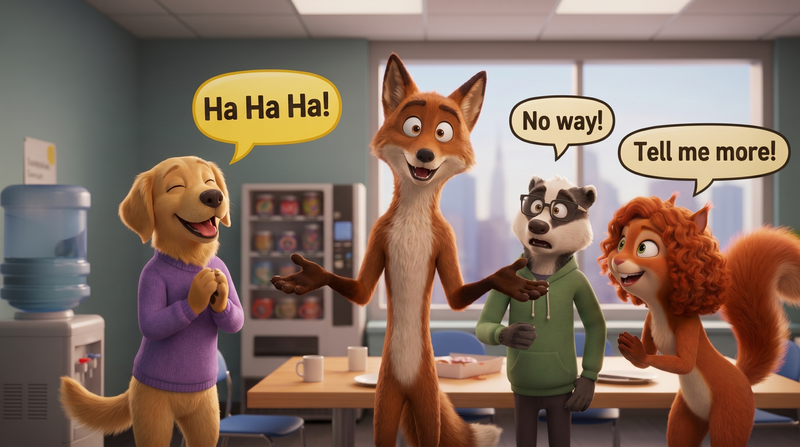 Imagesin this Byte created by the author via Nano Banana AI image generator
Stories add energy and connection to any chat, making you the kind of person people naturally want to talk to.
The real question is...how does someone actually get good at this?
Good news. You don't need special skills or a big, dramatic life story. You just need a simple way to turn everyday moments into short stories people enjoy.
A simple 4-part formula can turn you into an effective conversational storyteller.
Did you know?
Storytelling Formula
1. Skip the Backstory
 Mathew Dicks, in his book Storyworthy, discusses the value of cutting out unnecessary details and backstory to focus on what really matters.
What is backstory? Backstory is all the setup or background details before the exciting part.
Example: “Last month I had a big meeting. I woke up early and got dressed in the dark and…”
Why skip it? It slows your story down and bores people. Starting with a backstory kills the energy and makes listeners tune out.
2. Start with Action
 In Storyworthy, Mathew Dicks also talks about grabbing attention immediately.
Example: “You won’t believe what happened during my big client presentation…”
 Hook your listeners by jumping straight into the exciting or surprising moment instead of easing in slowly. Before telling any story, ask yourself: "Where does this story get good?" and begin there.
Examples:
Weak: “I was driving to work this morning…”
Strong: “I’m merging onto the highway this morning when my car starts making this loud grinding noise.”
Weak: “Yesterday in the team meeting…”
Strong: “I’m answering a question from my boss yesterday when I completely blank on the numbers.”
3. Vivid Middle
 Annette Simmons, in her book The Story Factor, talks about having a vivid middle by bringing it alive with just enough detail.
She uses a simple acronym for this: LATED. This expands on the hook without repeating it.
Location — Quick scene (describe the setting in a few words)
Actions — What happened step-by-step (key movements or things you did)
Thoughts — Your inner voice (what you were thinking or telling yourself)
Emotions — How it felt (the feelings you experienced)
Dialogue — Short quotes (key things people actually said)
4. Big Finish/Powerful Payoff
 Chip and Dan Heath, in their book Made to Stick, talk about ending with a powerful finish that delivers a twist, laugh, or lesson that wraps up your story and gives it meaning.
This is your chance to land the point — whether it’s funny, insightful, or useful — so the story feels complete and memorable.
 End strong, then pass the mic. Hand the conversation back to the group by asking a simple, open question. This turns your story from a one-person monologue into a real back-and-forth conversation and invites others to share their own experiences.
Examples:
“What’s the most awkward moment you’ve had at work?”
“Has anything like that ever happened to you?”
Big finishes often include:
A quick lesson learned
A humorous twist
How the moment changed you
A relatable question back to the group
Did you know?
Scenario

During a team lunch, a coworker shares:
“Last Tuesday I woke up at 6:15 a.m. because my alarm went off. I usually set it for 6:30, but I wanted to get to the office early for a big presentation. I brushed my teeth, made coffee, and then got dressed.
I drove to work, which took about 25 minutes because there was some traffic on the highway. I had prepared my slides the night before. I was in the middle of presenting the quarterly numbers when the boss asked a tough question I wasn’t ready for.
That moment taught me to always have a backup plan — and now I handle surprises much better. What’s the toughest unexpected question you’ve ever gotten in a meeting?”
Quiz
Which part of the 4-part formula for conversational storytelling is MISSING?
Pro Delivery Tips
Now that you have the structure, deliver your story with natural energy so it feels like a real chat, not a boring speech.
 Keep it short and bite-sized. Chunking information reduces the mental load of a story, sharpens the listener's focus, and improves their ability to retain the information, as supported by cognitive load theory.
Aim to keep your story within 1–3 minutes max — roughly the length of a quick coffee break chat.
 Show feelings, don’t list facts. As Mathew Dicks shares in Storyworthy, you should let people feel the moment with you. Instead of “I felt embarrassed,” say “My heart was racing."
 Use strategic pauses. The power of pausing is supported by storytelling and public speaking research, including the work of Carmine Gallo.
Pause at key moments to build suspense or let the funny/awkward part land. For example, pause after saying seomthing like, “I was hoping no one noticed…” It gives people time to react and makes your story way more engaging.
 Add light self-deprecation. Mathew Dicks suggests that lightly poking fun at yourself makes the story more relatable and funnier. For example: “I like to think I’m always prepared…but I once walked into an important meeting with my shirt completely inside out.”
 Read the room. Emotional intelligence and audience awareness in storytelling draws from Albert Mehrabian's research on nonverbal communication and empathic listening.
Watch their faces. If smiles fade, jump straight to owning the mistake and the laugh.
Scenario
During a recent team lunch, I shared a personal story about the time I meant to reply only to my manager to discuss workplace concerns but accidentally hit “Reply All”.
I began by saying:
“My stomach dropped and my face got hot the second I hit send…”
Then I paused, looked around the table, and continued for the next 5–7 minutes, providing various statistics:
“Did you know that according to a 2023 study by Email Analytics, over 42% of workplace email mishaps involve 'Reply All' errors? Another report from Harvard Business Review says that 67% of employees have experienced embarrassment from 'Reply All' incidents, and internal data from Fortune 500 companies shows that these accidents contribute to a 19% increase in email volume during the following week as people try to clarify or contain the fallout…”
Finally, I added with a grin:
“So yeah… after all that, I guess I should have practiced what I preach before hitting send!”
Quiz
In the scenario, which delivery tips did I use most strongly here? Select all that apply:
Subscribe for more quick bites of learning delivered to your inbox.
Unsubscribe anytime. No spam. 🙂
Formula in Action
Click play on the video below to check out this conversational story example, inspired by the author's real-life experience.
As you watch, challenge yourself to identify the four-part formula in action!
Video created by the author via Nano Banana, Seedance 2.0, ElevenLabs Voice Generator, and Clideo Video Editor
Were you able to spot the formula in action? Let's break it down:
Scene 1: Skipped Backstory and Started with Action
"I'm standing in front of the client team when I suddenly realize I'm wearing one black shoe and one brown shoe."
Scene 2: Vivid Middle (LATED Method)
"The whole team is in the big conference room on this 12th floor. My stomach drops.
Nobody will notice. Who even looks at feet? Brown and black are basically the same color. I'm a trend setter! I owned it with a quick laugh. Early mornings in the dark will do this to you."
Scene 3: Big Finish
"It actually lightened the mood. That small embarrassment taught me to always check my shoes in the light. What's the most awkward, 'I can't believe I did that' moment you've had at work?"
Did you know?
Quick Daily Practice
 Build your confidence as a conversational storyteller.
Pick one small moment today. It could be a missed deadline, awkward client call, surprise question in a meeting or class, coffee spill in public.
Shape it into a story using the formula, especially starting with action.
Tell it out loud or to someone.
Record yourself to check timing.
Take Action

The cool thing is, the more you practice conversational storytelling, the more natural it feels. At first, it might feel a little awkward, but after a few tries, it becomes something you do without even thinking about it. You'll start telling stories effortlessly in everyday chats!
Try these strorytelling strategies:
Your feedback matters to us.
This Byte helped me better understand the topic.