
AI will be as common in healthcare as the stethoscope.
— Dr. Robert Pearl, Stanford University School of Medicine
 Photo by Vitaly Gariev on Unsplash
Doctors have diagnosed patients for centuries without the use of artificial intelligence (AI).
So why are healthcare teams bringing it into the diagnostic process now? Find out in this fictitious scenario where a reporter caught up with DiagnosAI at a busy hospital to hear its side of the story.
Did you know?
Meet DiagnosAI
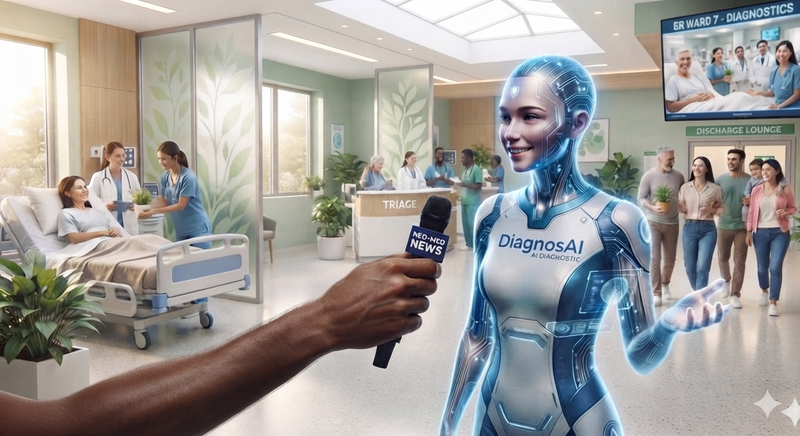 Image created by the author using Google Nano Banana
To hear an audio playback of the scenario, click the play button on each audio player.
Reporter: DiagnosAI, thanks for joining us. We’re here to talk about your role in healthcare and basically your reason for being. So, tell me, are you replacing doctors?
DiagnosAI: (stares into camera) Wow. We’re starting there? Not “Why do humans still use fax machines in 2026?”
Straight to the emotional damage. Fair enough.
No. I am not replacing doctors. I’m replacing something far less glamorous: The 17 browser tabs open in a doctor’s brain.
Reporter: Hmm, not sure what that means, maybe if you gave some real examples?
DiagnosAI: Gladly. Grab your coffee. I'm not allowed any (apparently it causes hallucinations). Probably for the best. I'd only spill it on an MRI machine anyway. Alright, let's walk through 3 real reasons healthcare teams keep me around!
Did you know?
1. Rare Disease Diagnosis
To hear an audio playback of the scenario, click the play button on the audio player.
Reporter: Ok, let’s hear it.
DiagnosAI: A patient came in with chronic severe back pain. The doctors and specialists listened, examined, ordered tests, and still something wasn’t adding up.
Reporter: Oh no.
DiagnosAI: That's where I earned my keep. I've been trained on gazillion patterns and rapidly scoured millions of patient records to find just a handful of similar cases that suggested the doctor should take a closer look at something ultra-rare. And guess what? Once steered in the right direction, the doctors found the issue — myofibrillar myopathy.
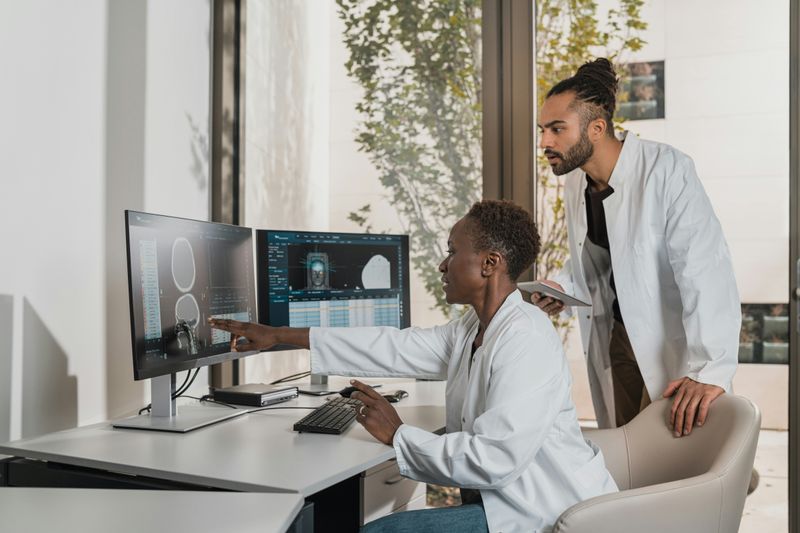 Photo by Accuray on Unsplash
Reporter: Never heard of it. Back up, so you diagnosed the patient?!
DiagnosAI: That's another question I hear 8,462 times a day! (Sigh) I didn’t diagnose anyone. The experts made the final diagnosis. I merely whispered: “Hey doc…maybe don’t ignore that weird little clue hiding in row 947.” That’s just a little AI humor.
Reporter: Ha ha, got it. Seriously, sounds like AI can serve as a great tool, reducing the time it takes to diagnose rare diseases and solve medical mysteries.
 Quiz
Quiz
Why do healthcare teams use AI for diagnosis?
A. Because AI can quickly process a ton of data to independently confirm a diagnosis, reducing the need for a second opinion.
B. Because AI can rapidly process massive amounts of patient and reference data to surface relevant findings a doctor can act on.
C. Because AI is generally more accurate at diagnosing patients with rare, uncommon, or complex diseases.
Quiz
Which answer is correct?
2. Scan Fatigue Relief
To hear an audio playback of the continued scenario, click the play button on the audio player.
Reporter: Ok, any other examples?
DiagnosAI: Another case involved a radiologist who’d been reviewing over a hundred images! Humans are incredible and brilliant. But humans are also…humans.
Imagine reviewing 150 chest X-rays in a row, hour after hour.
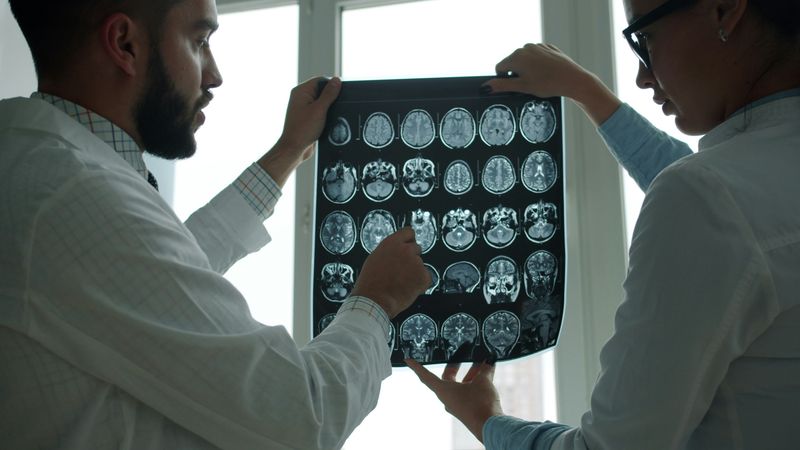 Photo by Vitaly Gariev on Unsplash
By scan #151, even the sharpest eyes start to blur. Me? I quickly scan the image, flag anything that looks off, and hand it back to a radiologist to confirm.
I don't blink. I don't start seeing shadows in my coffee at 2 am mostly because I'm not allowed coffee). And, I never ever get tired.
Reporter: So you’re basically the world’s most helpful proofreading side-kick for tired eyes?
DiagnosAI: Exactly. A proofreader with a medical degree’s worth of pattern recognition, but zero ability to drink coffee. Tragic, really.
Did you know?
Subscribe for more quick bites of learning delivered to your inbox.
Unsubscribe anytime. No spam. 🙂
3. Rural Healthcare Support
To hear an audio playback of the continued scenario, click the play button on the audio player.
Reporter: Ok, one last story, and this time with feeling?
DiagnosAI: I don't do feelings, but yes, I do have one more. One doctor, one tiny rural clinic, and a waiting room that never empties. Dr. O has diabetic patients who need annual eye exams, but the nearest ophthalmologist is 60 miles away and has a six-month wait!
Reporter: Ouch. So what does she do?
DiagnosAI: Dr. O snaps a photo of the patient's retina, and I check it for signs of diabetic retinopathy in seconds. If I spot something concerning, I flag it so the patient can be fast-tracked to a specialist.
Reporter: So you don't replace the ophthalmologist.
DiagnosAI: Nope! I just make sure Dr. O can make timely referrals and still see the 40 patients in her waiting room.
Reporter: Nice. I can see how AI can be used by an overworked rural healthcare team for support, not as a replacement. Thanks for taking the time to break this all down for us.
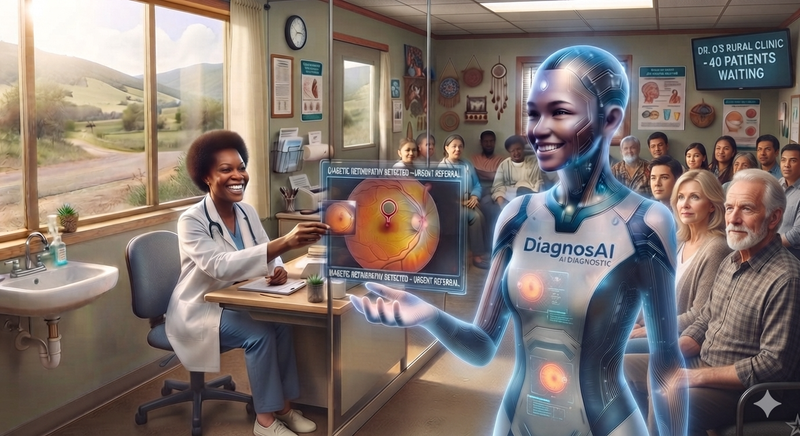 Image created by author using Google Nano Banana
Quiz
Quiz: How does AI help in this rural healthcare scenario? Select all that apply:
Take Action
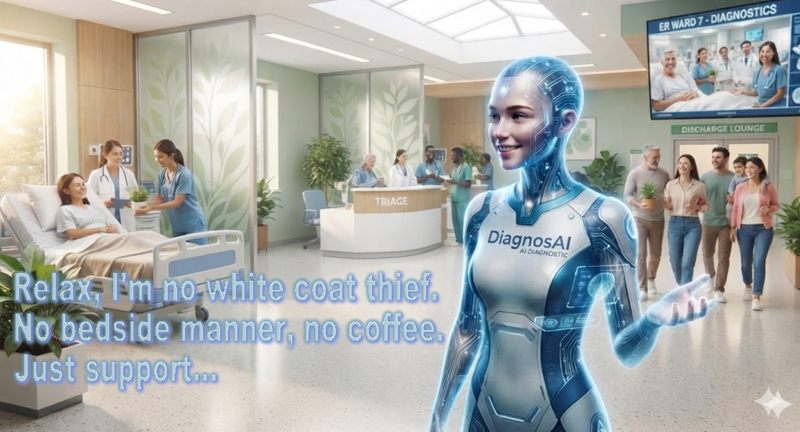 Image created by author using Google Nano Banana
The next time someone says "AI is coming for doctors' jobs," you'll know the real story: AI diagnosis tools are around to support doctors, not replace them. From accuracy to timeliness, AI diagnosis tools can make the difference between life and death.
So when you hear about AI for medical diagnosis, don't ask "Can AI replace doctors?" Instead, ask how AI can support doctors.
Your feedback matters to us.
This Byte helped me better understand the topic.