
 Photo by Glenn Carstens-Peters on Unsplash
You've sent out 30 applications this month. Maybe 2 replies. It's easy to start wondering if you're doing something wrong — or if it's even worth continuing.
Here's the thing: you can't control who replies to you but you can control what you do every day. A habit journal helps you track your effort, not just your results, so you can see progress even when your inbox stays quiet.
Track Habits, Not Just Outcomes
 Photo by Isaac Smith on Unsplash
Job searching has a problem: the outcomes you actually want (interviews, offers) are mostly out of your hands. But the actions that lead to those outcomes — applying, networking, practicing — are 100% within your control.
When you only measure success by replies or offers, long silences can feel like failure. When you measure it by what you actually did, you get a truer picture of your effort — and a reason to keep going.
Did you know?
What to Log in Your Habit Journal
The biggest habit-tracking mistake: tracking things you don't control. Only track what's fully within your power to do.

Track these (controllable):
Applications sent
Follow-up messages sent
Networking conversations started
Resume/cover letter updates made
Interview prep time (mock questions, research)

Don't track these (not habits):
Interviews landed
Replies received
Offers made
These are important outcomes, but they aren't habits. You may want to track them in a separate job search log or spreadsheet, rather than in your habit tracker.
 Quiz
Quiz
You applied to 3 jobs today but got no replies. Choose the best habit-tracker journal entry.
A. "No responses today, so it feels like I didn't make any progress."
B. "Applied to 3 jobs. No answer, but proud I stay consistent with my plan."
C. "Nothing changed today, so I'll leave today's entry blank."
D. "Applied to 3 jobs. My goal is to apply to 3 more jobs tomorrow."
Quiz
Select the best habit journal entry:
Setting Up Your Tracker
Pick a format you'll actually stick with — the "best" tracker is the one you'll use consistently.
 Image created by author using ChatGPT
Notes app: a running daily list — fastest option, good if you're tracking on the go.
Spreadsheet: one row per day, one column per habit, with a weekly total formula. Best if you want to see numbers add up over time.
Bullet journal grid: a simple weekly grid — one row per habit (e.g., "Applied," "Followed up," "Networked"), one box per day. Check it off when done. Great if you like a visual, at-a-glance streak.
Start simple. You can always add more structure later once the habit sticks.
 Here's an example of a habit tracker that you can apply to your job search.
Did you know?
Subscribe for more quick bites of learning delivered to your inbox.
Unsubscribe anytime. No spam. 🙂
Reviewing Your Entries

Set a fixed weekly review — 15–20 minutes, same day each week (Sunday evening works for a lot of people). Read back through the week's entries and ask:
Which actions did I actually keep up with, and which slipped? Be honest about what's realistic.
What did you notice while doing your habits? A quick note like "applications took less time than expected" or "networking felt easier this week" can reveal patterns over time.
What's one thing I'll adjust next week? More applications, a different approach to follow-ups, more prep time — pick just one.
This weekly habit is what turns daily check-ins into an actual feedback loop — showing you not just that you're working, but where to adjust.

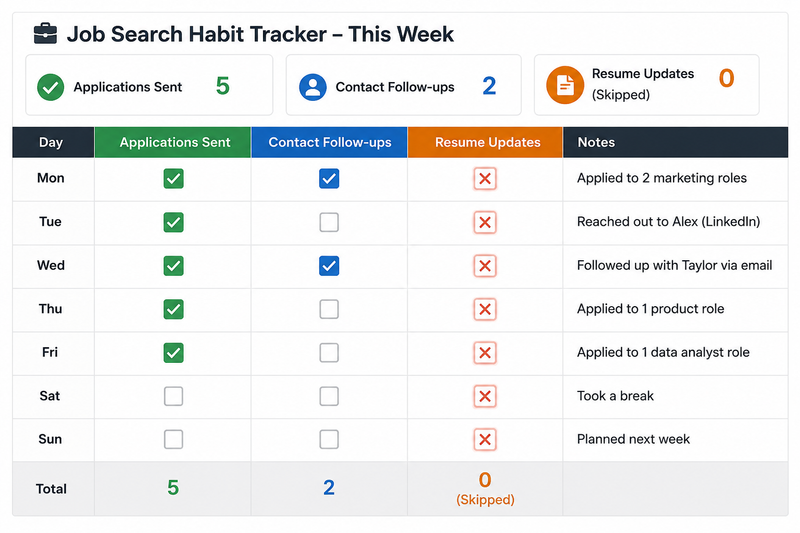 Image created by author using ChatGPT
Quiz
You're doing your Sunday review. Looking back, you applied to 5 jobs and followed up with 2 contacts — but you skipped resume updates all week, and one entry mentions a recruiter asked for a portfolio you don't have ready.
Which of these are good takeaways from this review? Select all that apply:
A. Note that resume updates keep slipping — adjust the habit to something more realistic, like once a week instead of daily.
B. Flag the portfolio request as a next step to prepare before the next application.
C. Since applications and follow-ups went well, ignore the missed resume habit entirely.
D. Pick one adjustment for next week instead of trying to fix everything at once.
Quiz
Select all takeaways that apply:
Using your Tracker To Stay Motivated
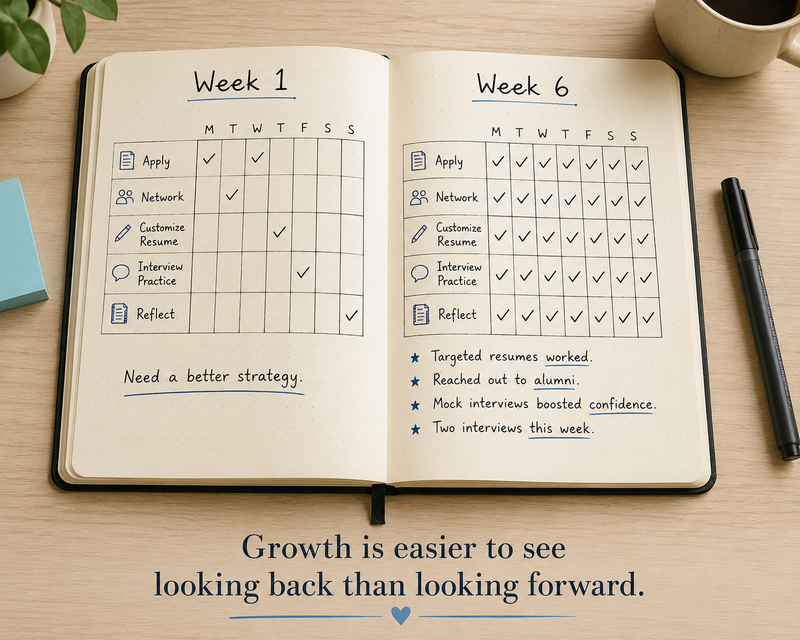 Image created by author using ChatGPT
On hard days, your checked boxes are proof that you showed up, even when nothing seemed to come of it. Flip back a few weeks and you'll usually see growth the daily entries didn't show in the moment: more consistent applications, stronger follow-ups, sharper targeting after your weekly reviews.
Bonus: This record is gold for interviews later. "Tell me about a time you stayed persistent" gets a lot easier to answer when you've got real weeks of effort — and the adjustments you made along the way — written down.
 Looking for extra motivation? Follow a career coach like @advicewitherin on Instagram for practical job search tips and encouragement.
Did you know?
Take Action
 Photo by Andrew Neel on Unsplash
Get started on your job search habit journal:
Your feedback matters to us.
This Byte helped me better understand the topic.