
Ever felt something strong but couldn’t name it — then reacted in a way you later regretted? For example, Maya, my friend, shared this story.
She had been running late when her coworker casually said, “You look tired today.” Something tightened in her chest. She snapped, “I’m fine. Why does everyone keep commenting on how I look?” Later she told me she felt embarrassed…but still couldn’t put her finger on what she had actually been feeling.
 All images created by the author via Grok and Articulate RISE AI image generators
As with Maya, that moment of not knowing the name for the feeling is exactly where things often go wrong. Research shows that when we put a feeling into words — its intensity often drops. This creates space so we can choose a better response instead of reacting on autopilot.
So how does Maya actually identify her feelings clearly enough to name them and respond differently? She starts by using the Plutchik Emotion Wheel. Let's explore.
Did you know?
Meet Plutchik’s Wheel of Emotions
Maya can use Plutchik’s Emotion Wheel, a visual map of how human emotions are structured, connected, and intensified. It helps learners see emotions not as random feelings, but as an organized system with patterns.
1. Primary Emotions (the core petals)
The wheel is built around eight primary emotions.
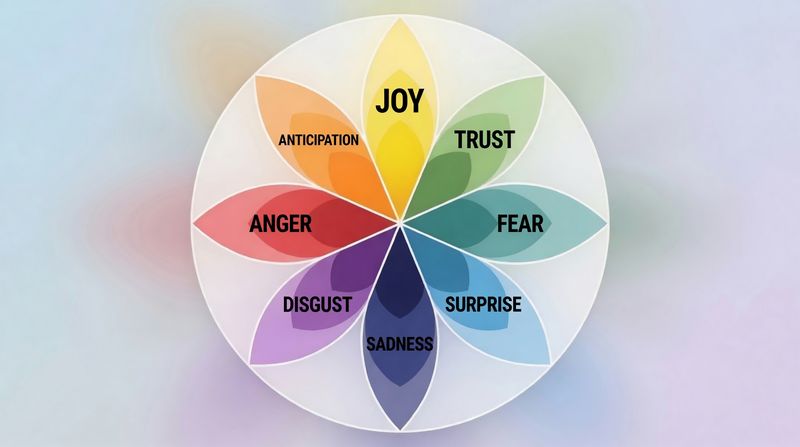 These are considered the “building blocks” of emotional experience — the simplest, most fundamental feelings.
2. Intensity (lighter → darker)
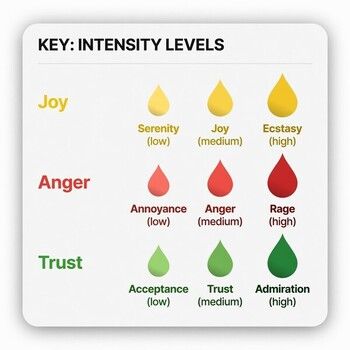
Each primary emotion has three levels of intensity, shown as layers of color. This shows that emotions aren’t fixed — they expand and contract depending on the situation.
Low intensity (outer layer)
Medium intensity (middle layer)
High intensity (inner layer)
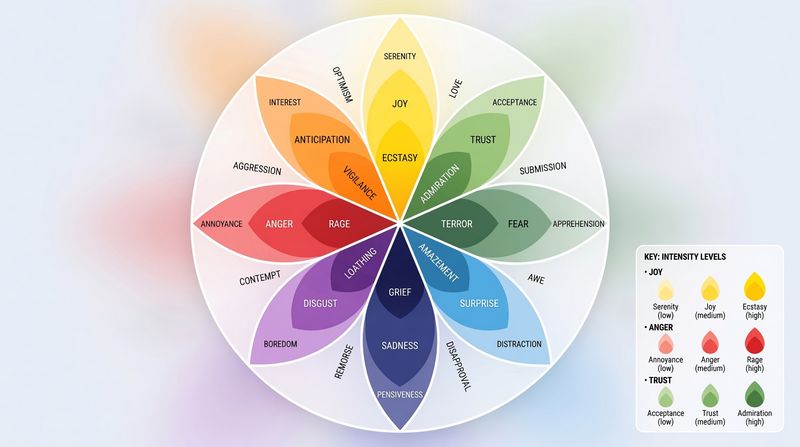
Here are examples using the primary emotions of joy, anger, and trust:
3. Opposites (across the wheel)
Each primary emotion has a direct opposite placed across from it. Opposites help learners understand why certain emotions can’t coexist easily (e.g., you can’t feel deep joy and deep sadness at the same moment).
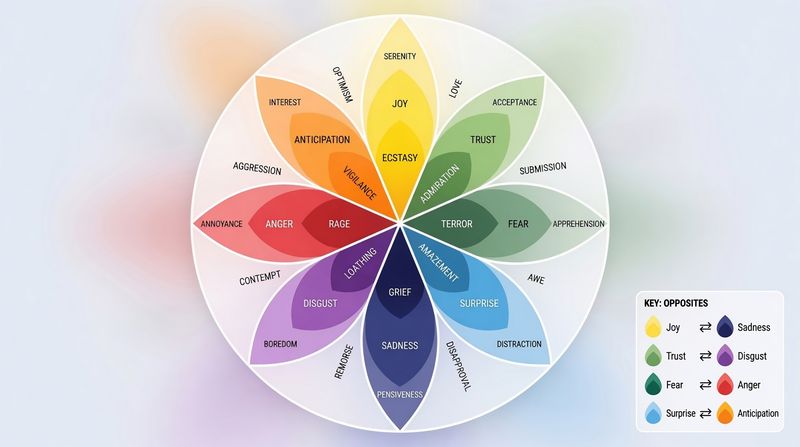
Here are examples using joy, trust, fear, and surprise:
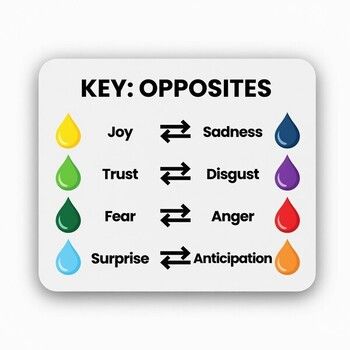
4. Secondary Emotions (where petals meet)
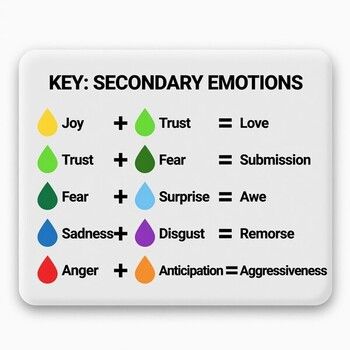
When two primary emotions blend, they create secondary emotions — more complex feelings. This is one of the powerful insights of the wheel. Emotions combine like colors to create new emotional experiences.
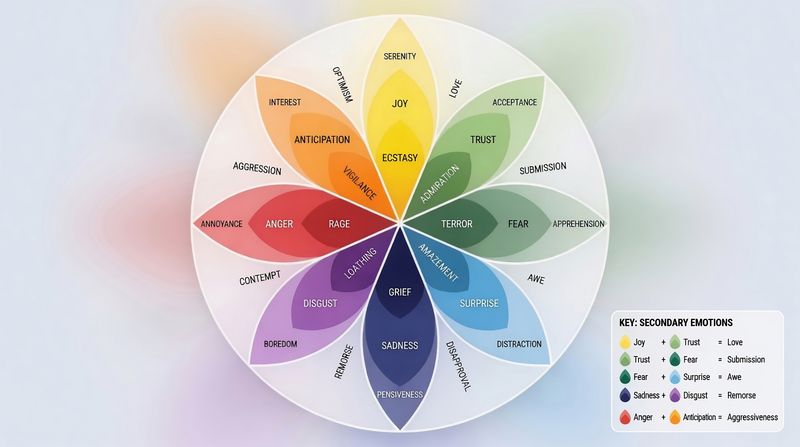
Here are examples of the secondary emotions of love, submission, awe, remorse, and aggressiveness.
Quiz
Why does Plutchik’s Wheel place secondary emotions where the primary petals meet?
Did you know?
Maya's Story (Using the Wheel)
The Emotion Wheel helps you see the emotion more clearly instead of staying stuck in a vague, overwhelming feeling.
Remember Maya’s story? She was running late when her coworker said, “You look tired today.” Something tight and hot rose in her chest. She snapped back and later felt embarrassed — but still couldn’t identify what she was actually feeling.
When Maya looked at Plutchik’s Wheel, the tight, hot sensation in her chest suddenly makes more sense. It lined up with anger (closer to annoyance) mixed with a bit of fear about how others were seeing her. Once she can see it on the Wheel, she is ready to name it.

Did you know?
Why Naming Helps
When you put a clear name to what you’re feeling, something helpful happens in your brain. The part that sounds the “alarm” (called the amygdala) often calms down.
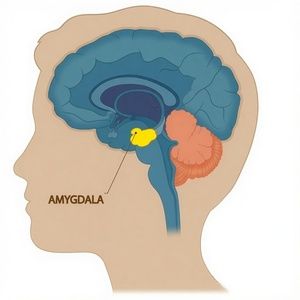 This creates a little space between the feeling and how you respond. You don’t even have to try hard. Just naming the emotion can gently lower its intensity. Scientists call this “implicit” emotion regulation — it works almost automatically.
Maya's Story (Naming Feelings)
Once Maya looked at the Wheel and named it — “That’s annoyance mixed with a bit of fear” — the heat in her chest softened. The annoyance had made her irritable and the fear was driven by insecurity about how others were seeing her. Naming it created space between the feeling and her reaction and allowed her to react differently.

Quiz
How does clearly naming an emotion create helpful space for a better response?
Did you know?
Subscribe for more quick bites of learning delivered to your inbox.
Unsubscribe anytime. No spam. 🙂
Simple 6-Step Practice
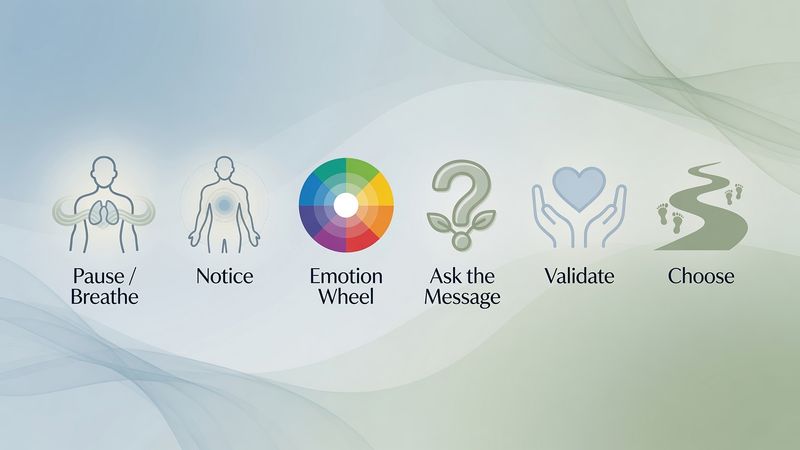
Here’s a simple 6-step practice that uses Plutchik’s Wheel of Emotions.
 You can try it the next time when a feeling shows up.
Pause and breathe. Take one slow belly breath (in for 4, out for 6). This interrupts the automatic stress response, calms the body, and creates the space you need.
Notice. What are you feeling in your body right now? (tight chest, hot face, heavy stomach?) This brings your attention out of racing thoughts and into the present physical signals.
Look at the Wheel and name it. Find the emotion (or mix of emotions) on Plutchik’s Wheel that feels closest. Notice how strong it is — closer to the center means more intense. Naming the feeling reduces its intensity and gives you clarity instead of being swept away by it.
Ask the message. What is this feeling trying to tell you or protect? This helps you understand the useful information the emotion is carrying rather than treating it as the enemy.
Validate. Acknowledge the feeling without judging it. You can say: “This feeling makes sense right now — even if my reaction wasn’t helpful.”
Validation lowers resistance and self-criticism so the emotion can begin to settle.
Choose. What is one helpful next step instead of reacting on autopilot?
This moves you from automatic reaction into intentional response.
You don’t have to get it perfect. Just start noticing, naming, and choosing. Every time you practice, you get a little better at it.
Practice Scenario
Alex is in a meeting when a teammate takes credit for work Alex completed. Alex’s jaw tightens, their face feels hot, and they feel a strong urge to call the person out right away.
Alex pauses, takes a slow breath, and notices the physical tension. Looking at Plutchik’s Wheel, the feeling that fits best is a mix of anger and disgust, fairly close to the center (strong intensity).
Quiz
What is a useful next step for Alex when working with this feeling?
Take Action
 You’ve got a simple way to visualize, name, and work with emotions. Give it a try with one of the actions below.
Your feedback matters to us.
This Byte helped me better understand the topic.