
The teacher said, "Today we are going to do a group project on the structure of the cell." My heart sank. Group projects were the worst! I wasn't interested in taking on extra work and scrambling to get it done on time.
 Photo by Jeswin Thomas on Unsplash
The teacher explained what we needed to do, and it sounded like a lot of work! She looked over and realized how panicked I looked. With a twinkle in her eye, she wrote on the board:
"Before anything else, preparation is key to success." — Alexander Graham Bell
I decided to take that advice seriously! Before I knew it, I had turned a challenging group project into one of my most rewarding experiences at school.
Planning Your Project
When I started this project with four of my classmates, we were unsure about how to begin. We all had different strengths, learning styles, and schedules. Instead of jumping right into the fire, we realised time spent planning would save us work in the long run.
 Here are some tricks we picked up along the way.
1. Assign roles.
It's important to put the right person in the right role.
Leader: Makes decisions.
Editor: Checks for mistakes
Tech lead: Deals with technical issues.
2. Decide how you want to do the project.
It's important to agree on how a project will be done.
When and where will you meet?
How will you communicate with each other?
How will you share work?
When will different things need to be done?
Managing Your Time
With two weeks left for the project deadline, we knew it would be easy to let the work pile up till the last minute. We talked about this and realised that if we agreed to do the work a few days earlier, and had the date written down for each step, our lives would be much easier.
1. Complete the project before the deadline.
If your group agrees to finish the work before it needs to be submitted to the teacher, you have time to check it, refine it, and make sure that everyone's pieces fit together well. This gives you some wiggle room to finish on time in case something takes longer than expected.
We hand the project in on May 5.
All sections completed by May 3.
2. Use a progress tracker.
If you write down who is responsible for different tasks and when they're expected to finish their part, it becomes easier to manage. A simple progress tracker can do the trick!
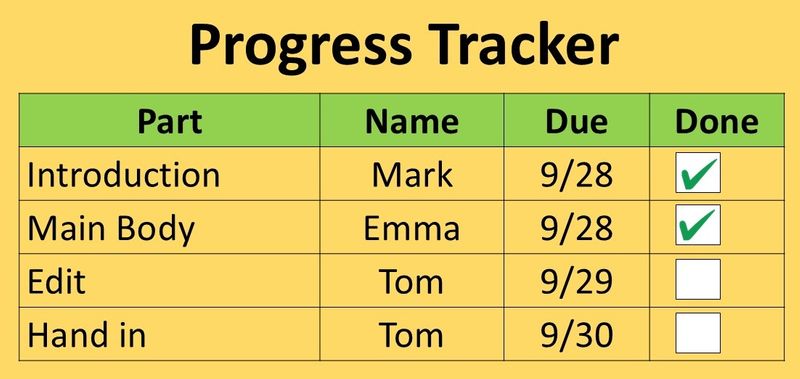 Image created by the author
You might want to check out other templates like this Group Project Planner template on Notion.
Quiz
If a project must be handed in on November 14, when is the best day to have all the written work sent to the editor?
Communication
Even before we started working together, it was clear to us that we all had different personalities and communication styles. This made us realise that a few guidelines on speaking in a positive, friendly way would ensure this project was a better experience for everyone.
What you should say:
Is there anything I can do to help you with that?
May I offer a suggestion?
We might want to think about...

What you shouldn't say:
That isn't right.
When will you get your work done?
This isn't what I expected from you.

Quiz
One of your teammates has not started working on their slides for a group presentation due in three days' time. What is the best thing you can say?
Subscribe for more quick bites of learning delivered to your inbox.
Unsubscribe anytime. No spam. 🙂
Take Action
Group projects can be tough, but with these tips, you'll be well on your way to a successful and rewarding group project.
 Photo by Brooke Cagle on Unsplash
Your feedback matters to us.
This Byte helped me better understand the topic.