So you have been looking for work for a while with little success or you aspire to a role and want to know how to get there. Where do you start?

Conducting a skills gap assessment could be just what you need to get on the right track!
What Is a Skills Gap Assessment?
What Is a Skill?
To answer this question, you first need to understand what a skill is.
A skill is a combination of learned knowledge that is applied through practice and experience.
This video explains the difference between skills and abilities.
In summary: skill = knowledge on how to do something + experience applying the knowledge.
What Is a Skills Gap Assessment?
A skills gap assessment allows you to identify where you are vs. where you want to be. Once you have this information, you can figure out what you need to do to bridge the gap.
The following infographic explains this concept:
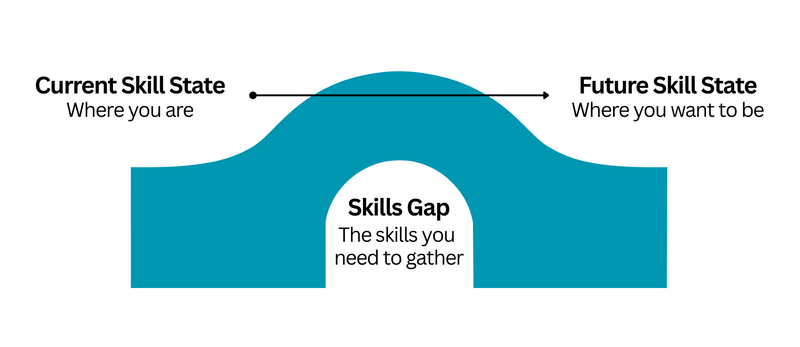 Image created by the author. To hear an audio description of the image, click play on the audio player below.
Did you know?
Conduct a Skills Gap Assessment in 3 Steps
You'll need to identify your skills gap before moving on to developing a plan to gain the knowledge and experience you need.
 Step 1: Future Skill State | Research
Although it may seem counterintuitive, you'll need to work backwards to effectively conduct a skills gap assessment.
This starts with understanding the role you want. You can do this by searching for the role on job boards like Indeed or LinkedIn.
As you research your role, make a list of the things an employer wants you to do.
For example, for a role in customer service, the employer might say "Communicate effectively with customers and colleagues" in the job posting.
 Step 2: Current Skill State | Self Assessment
Make an honest assessment of where you stand in relation to what you identified in your research.
Continuing with the previous example, think about the following:
Do you know what the principles of effective communication are?
If so, have you communicated with customers or colleagues in a workplace setting before?
If the answer is no to both of these questions, you could have a knowledge and ability gap.
If the answer is no to question 1, you could have a knowledge gap.
If the answer is no to question 2, you could have an experience gap in applying your knowledge.
 Step 3: Skill Gap Analysis
Identify the areas in which you have a knowledge gap, an application gap of this knowledge, or a skill gap (both knowledge and application).
Look out for repeating patterns. These will reveal your core focus areas and themes. Document key insights and themes throughout.
Gain Knowledge

Bridge your knowledge gap through these methods:
Formal learning: face-to-face learning, online courses, and training workshops.
Informal learning: learning from others, hands-on learning, and independent or self-guided learning.
Advantages and Disadvantages of Each Method
 Formal Learning
This usually happens at a university, college, or vocational institute, or through an online course provider.
Advantages ✅
Generally recognized and easy to prove to employers, as certificates and transcripts are generally provided.
Very portable
Structured
Provides knowledge in logical sequence
Disadvantages ❌
Can be expensive
Entry requirements or prerequisites
Generally inflexible
Knowledge may be outdated
Provides few opportunities to apply the knowledge
 Informal Learning
This usually takes the form of apprenticeships, work placements, internships, and workplace training. It's very common in industries where knowledge is passed down from one generation to another or from a master to an apprentice.
Advantages ✅
Could be inexpensive or free
In some cases may carry an allowance
Little to no entry requirements or prerequisites
May provide both knowledge and the opportunity to apply it and gain experience
Disadvantages ❌
May not be recognized by employers unless a letter or reference is provided by the teacher, master, or employer
Not very portable
May not be structured
May not provide the knowledge in the right sequence
Resources
Did you know?
Subscribe for more quick bites of learning delivered to your inbox.
Unsubscribe anytime. No spam. 🙂
Quiz: Ahmed's Knowledge Gap
Ahmed loves to cook! One of his friends notices how good his home cooked food is and suggests that he become a chef after completing school.
Ahmed likes the idea and decides to pursue the idea of becoming a chef.
 Image courtesy of Freepik
After some research online, Ahmed realizes that although he has a basic knowledge of cooking at home, he doesn't have knowledge or skills related to:
creating or following menus
managing inventory
many other tasks a chef does in addition to cooking
Quiz
What type of learning would best help Ahmed overcome his knowledge and skills gaps?
Gain Experience
You might have the knowledge needed through formal learning to do a job. But what if you're unable to find a job that allows you to practice the real-world application of that knowledge?
Or you may have opted for informal learning and are looking for an apprenticeship or internship.
How do you set about looking for such an opportunity? Where do you start?
 Gain Experience After Formal Learning
University/College Internships or Co-ops 🤝
Many universities or college programs provide or help you find opportunities for paid or unpaid internships or co-ops as part of the program. These are generally easier to get into than applying for them externally.
For example, the type of culinary school program that Ahmed hopes to attend would usually have an internship or co-op requirement. He would need to complete this in order to graduate.
Note that if you're studying abroad, some of these positions are only open to students in an eligible program.
Volunteering ✋
Search for local or online volunteer positions. These are usually at charities or not-for-profit organizations and are a great way to serve your community while gaining experience.
University or College Positions 🎓
Most universities and colleges have temporary positions that are open only to students. Ask your course coordinator where these positions are listed on the school's job boards.
 Gain Experience & Knowledge with Informal Learning
Apprenticeships 🪴
In some industries, a master or craftsman who has worked in the industry for a long time may need an assistant. They might be willing to pass down their informal knowledge to you.
These opportunities do exist, but they're harder to find. A good place to start inquiring would be local trade or craft shows and industry events.
For example, if Ahmed can't afford to go to culinary school, he could find an apprenticeship at a local restaurant and work his way up to become a chef.
Workplace Training 🧑💼
Some workplace roles may have no entry requirements other than primary or secondary education, or just the ability to speak the local language. In such roles, the organization would provide you with training on how to do a given job.
They may also offer an internal training program that allows you to progress within the organization based on experience and additional training.
Check Your Skills Gap Progress
 Step 1: Periodically revisit your skills gap analysis.
Is the method you chose to bridge your knowledge gap helping you to gain the knowledge you needed?
For example, Ahmed identified "managing inventory" as a key skill he didn't have.
Prior to enrolling in his culinary school program, Ahmed visits the program website and reviews the course outlines to see if there are courses that cover this topic.
 Step 2: Actively pursue opportunities to bridge skill gaps.
Just signing up for a program to fill your knowledge and ability gaps doesn't automatically guarantee that you will get the skill that you need.
You need to actively find and participate in opportunities that allow you to actually bridge your skills gap.
For example, during his internship, Ahmed volunteers for produce ordering, receiving, stock taking, and other tasks related to managing inventory.
 Step 3: Reflect on what you've learned and applied.
Reflection on the knowledge you gained and how you applied it to gain a skill is an important part of this process.
Ahmed does this by keeping a journal on what he learned and applied throughout the culinary school program and internships he completed.
Quiz: Ahmed's Skills Bridge
 Photo by Or Hakim on Unsplash
Ahmed has reviewed the culinary school program. He's sure that it will help him overcome much of his skills gap.
At the end of his two-year program, he needs to complete a 3-month internship at a bakery operated by the school. It's a requirement to graduate. Ahmed is excited about this opportunity and looks forward to his internship.
However, after starting the internship, Ahmed realizes that he won't get an opportunity to manage inventory.
Which of the following steps can Ahmed take to bridge his skills gap?
A. Quit the internship and the culinary school program. Find a different program that will provide him with the experience.
B. Speak to his program coordinator to find other ways that he can get the required experience.
C. Complete the program, then seek another internship that will provide him with inventory experience.
D. Continue the internship. Proactively ask the supervisor for more hands-on tasks and shadowing opportunities to manage inventory.
Quiz
Select all answers that will help Ahmed bridge his inventory skills gap:
Take Action
Your feedback matters to us.
This Byte helped me better understand the topic.