
Do you love the outdoors but also enjoy problem-solving, science, and making a real impact?

A forestry degree isn’t just about trees — it’s about protecting ecosystems and shaping sustainable futures.
It opens doors to exciting, meaningful careers where your work truly matters.
Did you know?
What is Forestry, Really?
Forestry is the science and practice of managing forests for multiple purposes:
Environmental protection (biodiversity, climate, water)
Sustainable resource use (timber, non-timber products)
Community and economic development
It blends biology, geography, technology, business, and policy — making it one of the most versatile environmental degrees.
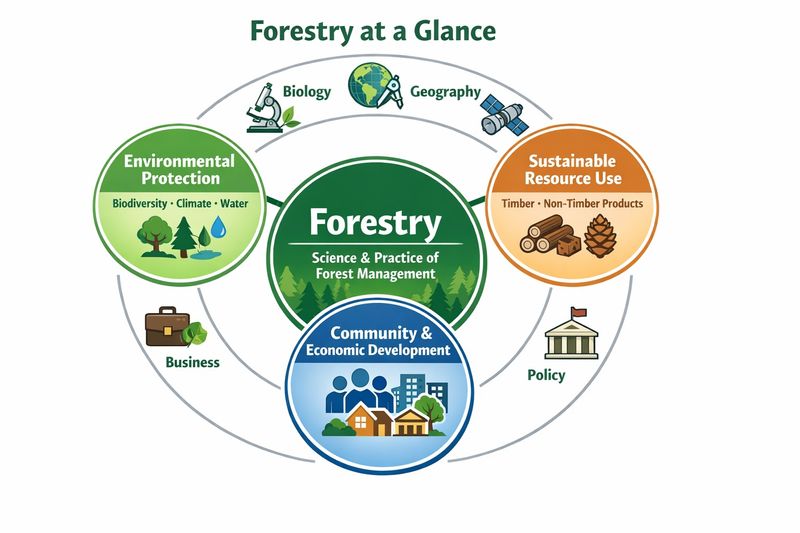 Image made by the author in Canva
Quiz
Forestry blends biology, geography, technology, business, and policy. Which of the following scenarios best illustrates how these areas work together in real forestry practice?
A: A company harvesting trees quickly to increase profits without environmental planning.
B: Experts monitoring wildlife, mapping forests, and managing timber with community needs.
C: A government office creating forest laws without studying environmental conditions first.
D: Visitors exploring a forest area mainly for recreation and sightseeing activities.
Quiz
Which scenario best demonstrates this combination in practice?
Forestry Career Paths
If you still picture forestry as only swinging an axe, think again!
 Today, forestry careers can take you everywhere — from offices and labs to classrooms, construction sites, government offices, timber mills, and, of course, out in the forest itself.
Modern forestry careers include a wide range of roles, from managing forest health and preventing wildfires to using technology to map landscapes, conducting research, teaching others, and shaping environmental policies.
Forestry careers combine science, technology, conservation, and community development.

Education and skills you need in forestry careers:
Science degree or diploma — foundational knowledge of forestry, biology, or environmental science.
Tree physiology knowledge — essential for understanding forest health and growth.
Working independently and with diverse teams — foresters often manage projects alone in the field but they also collaborate with others.
GPS and mapping technology skills — critical for planning, monitoring, and managing forest areas.
Good communication skills — to report findings, work with communities, and coordinate with teams.
Consider these forestry career paths you could take with a forestry degree.
1. Conservation Scientist
Ever wondered who makes sure our forests, parks, and wildlife thrive for future generations? Conservation scientists!
What does a conservation scientist do?
Uses scientific research to protect species, habitats, and ecosystems
Conducts field, lab, and desk-based research to analyze ecological data, use geographic information systems (GIS) and mapping tools, and communicate findings to support conservation decisions
Forestry career skills that are most important for a conservation scientist:
Physical stamina
Critical thinking skills
Analytical skills
Watch the video below to learn more about this forestry career:
Salary expectations:
In the US, conservation scientists typically earn between $62,410 and $81,546 per year.
In Canada, they typically earn between $44,000 and $58,000 per year.

Subscribe for more quick bites of learning delivered to your inbox.
Unsubscribe anytime. No spam. 🙂
2. Forester
Can you name the different types of trees and vegetation found in the forest? Do you make good decisions and think things through carefully? Are you interested in leading and managing people, but can also work effectively alone?
Then you may want to grow into a career as a forester.
What does a forester do?
Foresters help manage and protect forests, balancing conservation with human and ecological needs.
Foresters can work in government, consulting, non-profits, the forest industry, and educational institutions.
The video below shows a forester explaining the importance of his work:
Duties as a forester:
Meeting with the public, government, or recreation groups
Project management e.g timber harvesting and reforestation
Accumulating data
Analyzing the data to create forest management plans
Research and product development
Forester salary:
Foresters’ salaries vary depending on experience and location. Entry-level foresters typically earn around $45,000 per year, while experienced professionals can make up to $92,000 per year. The average salary in the Cananda is about $63,000 annually.
In the US, the average yearly salary for a forester is $55,644.

3. Educator
A forestry degree teaches you about trees, nature, and how to take care of the environment. Graduates can work as environmental educators, helping people learn about nature and encouraging them to protect it.
Education-related careers with a forestry degree include:
 Naturalist Field Guide (Eco-Tourism & Nature Reserves)
Field guides are nature experts who study plants, animals, and landscapes lead educational nature walks, share knowledge through media and events, and promote environmental conservation. An average salary ranges from $39,000 (entry-level) to $63,000 (senior roles) per year.
 Park Ranger
Park rangers protect the environment, wildlife, and park visitors. They patrol parks, enforce rules and regulations, complete reports and administrative tasks, and take charge during emergencies.
Rangers work both outdoors and indoors and need strong communication, people, and leadership skills. Salaries typically range from $40,000–$55,000 per year, depending on location and experience.
 Conservation Science Educator
These educators teach and mentor students preparing for forestry careers, conservation, and environmental fields.
Responsibilities include delivering lectures, designing lesson plans, grading and supporting students, conducting field and laboratory research, and analyzing data. Salaries typically range from $27,684 to $51,696 a year.
Quiz: Sarah's Forestry Career Path
Meet Sarah. She wants to become a naturalist field guide, teaching people about plants, wildlife, and ecosystems outdoors.

Which actions would best help Sarah prepare for this role?
A. Join guided nature surveys to practise identifying species and observing ecosystems in real settings.
B. Focus mainly on advanced laboratory research techniques used in controlled environments.
C. Develop ways to explain ecological ideas to visitors of different ages and knowledge levels
D. Specialise in technical scientific writing for academic journals only.
Quiz
Choose the best options for Sarah's forestry career path:
Take Action

Your feedback matters to us.
This Byte helped me better understand the topic.