
You're new to the country and participating in your first project meeting.
After the presenter concludes, they ask, "Does anyone have suggestions or concerns?"
The room becomes awkwardly silent.
Does this silence mean none of the participants have any questions?
Not necessarily.
Different countries and organizations have different cultures. In the above example's culture, it could be rude to ask someone senior to you questions, or to challenge what they have said.
Geert Hofstede describes this gap between senior and junior as the Power Distance Index (PDI).
Understanding these cultural tendencies can help you avoid misunderstandings when working with colleagues from different backgrounds.
What is the Power Distance Index (PDI)?
The Hofstede cultural dimensions Power Distance Index (PDI) refers to the extent to which people in a society generally accept unequal distributions of power.
The image below shows how power distance varies among countries on the PDI scale. As shown in the image, Austria, Denmark, and New Zealand have the smallest power distance and the Philippines, Malaysia, and Slovakia have the largest power distance.
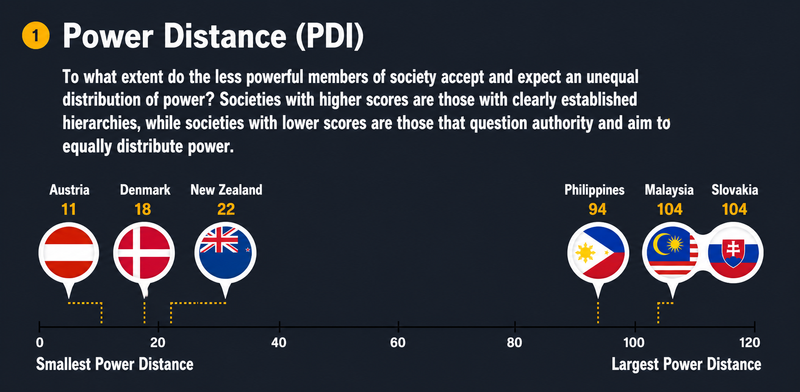 Image recreated by the author in ChatGPT. Play the audio clip below to listen to a description of this image.
In workplaces, this can influence expectations about:
How decisions are made ✅
Whether employees openly question managers ❓
How feedback is shared ✉️
Communication between leaders and team members 🗣️
Did you know?
Effects of PDI on Workplace Communication
Power distance can shape everyday workplace interactions, from how meetings are run to how employees share ideas with managers.
1. Lower Power Distance Workplaces
In countries that generally score lower on the Hofstede cultural dimensions PDI, employees often view managers as coaches or collaborators rather than distant authority figures.
Leaders may:
Encourage open discussion.
Invite feedback
Involve employees in decision-making.
Signs of a low PDI workplace:
Managers invite questions and debate.
Employees comfortably share ideas and feedback.
First names are used regardless of seniority.
Decisions are made collaboratively.
Workplace Example: Low PDI
During a project meeting in Canada or Denmark, a junior employee respectfully suggests an alternative approach to a manager's proposal. The manager welcomes the discussion because constructive feedback is viewed as helping the team make better decisions.
 Photo by Mapbox on Unsplash
2. High Power Distance Workplaces
In countries that generally score higher on the Hofstede cultural dimensions PDI, organizational hierarchy may play a larger role in daily interactions.
Employees often expect that:
Managers will provide direction.
Leaders will make important decisions and accept responsibility for them.
Signs of a high PDI workplace:
Greater respect for titles and formal roles.
Employees wait for an appropriate opportunity before speaking.
Senior leaders communicate decisions.
Feedback is shared privately rather than in large group meetings.
Workplace Example: High PDI
In some organizations in Malaysia or India, employees discuss concerns with their manager after a meeting instead of publicly disagreeing during the meeting, in front of senior colleagues. This approach can reflect respect for workplace hierarchy rather than a lack of ideas.
 Photo by Yura Timoshenko on Unsplash
Did you know?
Every Workplace is Different
Although national culture can influence workplace expectations, no two organizations are exactly alike.
1. Local Workplaces
Local organizations often reflect the values and communication styles of the community where they operate.
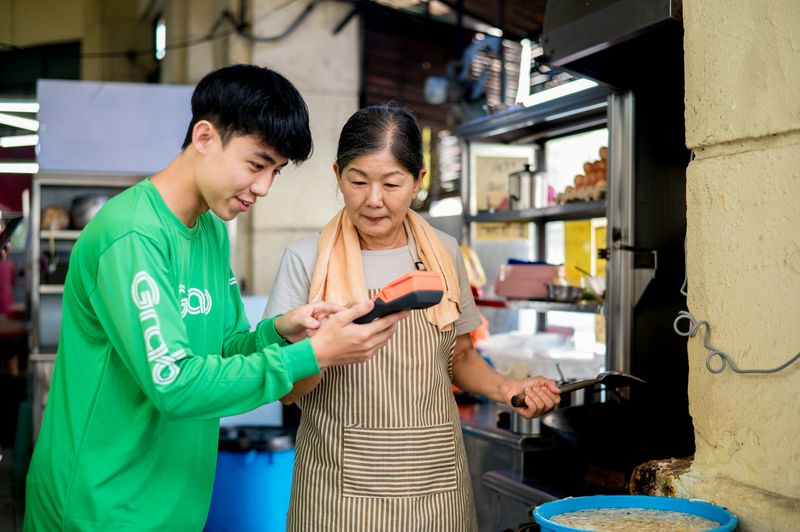 Photo by Grab on Unsplash
For example, a family-owned business in Indonesia may have a clear hierarchy where senior leaders make important decisions, and employees show respect through formal communication.
2. Multi-National Workplaces
A global airline such as Emirates in the UAE may follow international aviation standards to ensure safety and consistency. But, they also incorporate Middle Eastern cultural values such as respect for seniors and elders, loyalty, and honesty due to being a high PDI culture.
A North American technology company such as Google encourages employees worldwide to contribute ideas and openly challenge senior leaders regardless of seniority. This is because the leadership has a low PDI culture.
 Photo by Vitaly Gariev on Unsplash
Knowledge Check
A new employee joins a multinational company. During meetings, they notice that some colleagues openly challenge managers' ideas, while others wait until after the meeting to share feedback privately.
According to power distance in Hofstede's cultural dimensions theory, what is the best explanation for this difference?
A. Some employees are more committed to the organization than others.
B. Employees may have different expectations about authority, hierarchy, and how feedback should be communicated.
C. Employees who speak privately with managers are less confident.
D. Employees who challenge managers publicly are being disrespectful.
Quiz
Select the best explanation:
Subscribe for more quick bites of learning delivered to your inbox.
Unsubscribe anytime. No spam. 🙂
Tips for Working Across Cultures
Building cultural awareness means being curious, flexible, and respectful.
Instead of assuming your preferred communication style is the "right" one, consider how a colleague may have learned different workplace expectations.

In the video below, Erin Meyer, a professor and author of the book The Culture Map tells a story about practical strategies for working across cultures:
Key takeaways from the video:
Communication goes beyond words. Different cultures rely on different verbal and non-verbal cues.
Learn to "read the air". In cultures like Japan, much of the message is communicated indirectly. Pay attention to context, silence, and unspoken social cues.
There is no single "right" way to work. Understanding the situation and adjusting your communication style leads to better relationships and outcomes.

Workplace Tips
Observe how meetings are typically run before jumping in. 👀
Notice whether feedback is usually shared publicly or privately. 👁️
If you're unsure, ask your manager or teammates how they prefer to communicate.
Adapt your communication style while remaining respectful and authentic. 📈
Did you know?
Final Quiz
You have recently joined a multinational company that has teams in Canada, Japan, India, and the United Arab Emirates. During a virtual project meeting, you notice different communication styles among team members.
 Photo by Kimberly Nguyen on Unsplash
Some employees openly challenge the project manager’s ideas and suggest alternatives during the meeting. Other employees listen carefully, take notes, and share their feedback privately with the manager afterward.
As the project lead, you want to create an environment where everyone feels comfortable contributing.
Thinking back to how power distance works in Hofstede's cultural dimensions, what is the best approach to take?
A. Ask all employees to provide feedback publicly during meetings because speaking openly shows engagement.
B. Assume employees who don't speak during meetings are not interested or do not have ideas.
C. Recognize that employees may have different communication preferences related to workplace norms and provide multiple ways for everyone to contribute.
D. Require all teams to follow the communication style used by the company's headquarters.
Quiz
Select the best approach:
Take Action

Your feedback matters to us.
This Byte helped me better understand the topic.