Lucy's mining journey started with curiosity.
During COVID, Lucy was in high school, taking online classes like everyone else.
One room over, her dad was working from home. She could always overhear him taking calls, so she'd ask him jokingly, "How's the project going?"
One day, he offered to show her what he was working on. As a mineral engineer, his job was to analyze valuable metals from rocks on mining projects. She got pretty curious about the whole thing, asking question after question about the job. The answers made her even more curious.
 Lucy on campus during her mineral engineering degree.
What started as a joke became a fascination, leading Lucy to study mineral engineering at university. When she had the chance to do a co-op program at a mine, she brought that same unstoppable curiosity along for the ride.
From the Classroom to the Mine
After her first two years studying mineral engineering, Lucy wasn't sure if she'd made the right decision.
"I was skeptical. Classes were really theoretical," she explains. While she didn't mind the lectures, lab classes, and textbooks, she wanted to see the big picture.
Everything changed when her class took a field trip to a mine. It was her first experience underground, and it totally opened her eyes.
"It all started to come together for me when I toured the mine," Lucy reflects. "I started connecting everything I was learning in class to how it works in the real world. I realized that everything I'm learning is for a reason."
She knew right then that mining was her future. When the opportunity for a summer co-op program at McEwen's Fox Complex came up, Lucy dove in headfirst.
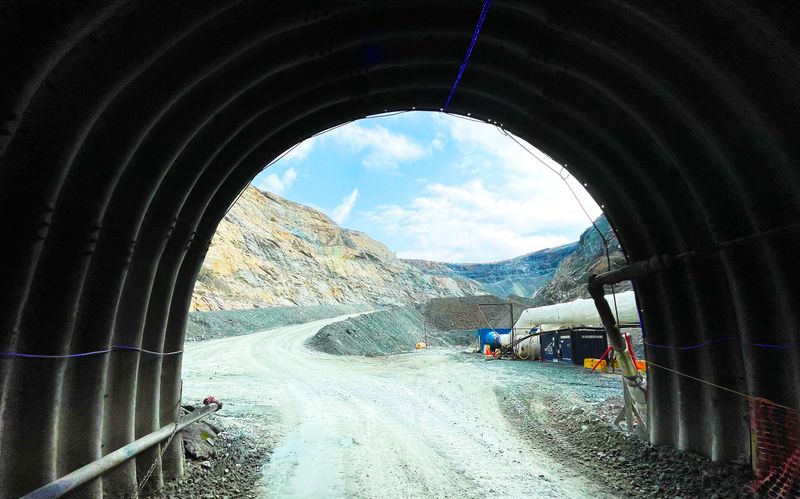 The entrance to one of McEwen's Fox Complex mines.
Did you know?
Teamwork, Not Guesswork
Lucy spent a summer working in the assay lab at the Fox Complex's production mill. It's a facility that supports recovery, a process that separates gold from rock.
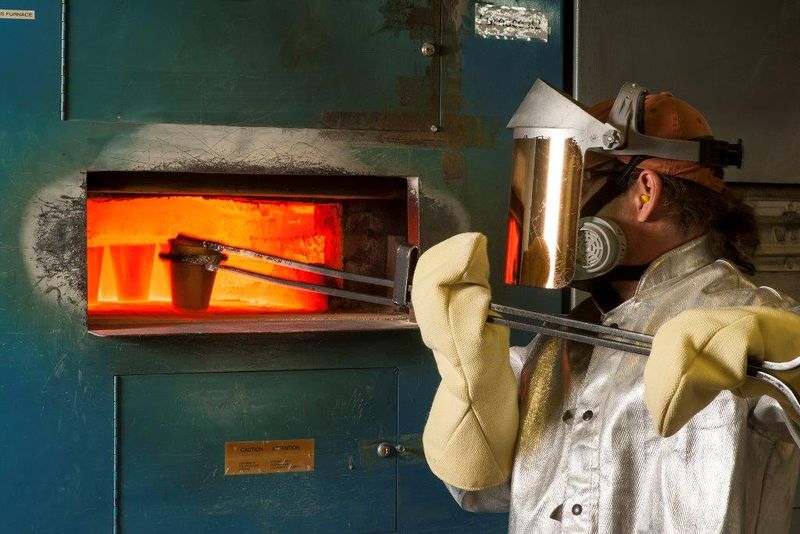 A McEwen employee working in the assay lab at the Fox Complex.
The assay lab team is the backbone of a gold mine. It's their job to prove that the mill is actually recovering valuable gold from all that rock efficiently. Using advanced science, they run fire and chemical tests on rock samples to eliminate guesswork and replace it with hard data.
The assay lab team then analyzes the data and sends daily reports to the mine. The reports tell the mine's operations team how much gold it's recovering and how much is lost in the process.
It's a fast-paced, high-responsibility environment — the perfect training ground for a student engineer like Lucy.
Did you know?
Know What You Don't Know
"It was my first 'big girl job' in engineering. I was super nervous," Lucy says. "I thought I had to know everything."
When supervisors quizzed her about different test processes, she quickly realized how much she didn't know. But instead of getting discouraged, she used it as the perfect opportunity to fill in her knowledge gaps.
"A lot of people focus on what they know, and they latch on to it. But I always ask myself: what do I NOT know, and how can I connect it with what I do know?"

With a learning mindset, she took the initiative and committed to improving her skills.
Subscribe for more quick bites of learning delivered to your inbox.
Unsubscribe anytime. No spam. 🙂
Communication Is Key
The most important lesson Lucy learned in her time at the mine: "Effective communication is the pinnacle of the industry."
If she didn't know something, she asked someone on the team. "I used to think that asking questions meant, Hey, look at me! I don't know what I'm doing! I thought it was a big red flag," she explains.
"But asking questions got me to think about my role in a deeper way. And my team was so open and helpful. I got so many great answers."
For Lucy, good communication wasn't just about asking questions. It was a two-way street that meant listening to others.
When her coworkers in the lab would talk about their daily tasks, Lucy would turn her chair around and "lock in" on their conversation. "I wanted to learn everything I could about their jobs and how they did them. Maybe I'll need to know those things someday."
Most importantly, she listened to feedback from her supervisors. In meetings, she took their constructive criticism to heart and kept asking questions about her performance. Then she'd ask herself: "What have I learned, and how can I adapt my work so I can get the job done better?"
In the end, she wasn't content to just absorb all these discussions. She actively used them to improve her skills. "I can't praise enough how much I learned from my co-op team."
Quiz: The Lab Report
You're working a shift in the assay lab at a gold mine. While preparing the daily report after a series of furnace tests, you notice data that looks unusual and confusing.
What's the best way to handle this situation?
A. Leave the confusing data point out of the final report. If it doesn't make sense to you, it will only confuse the operations team.
B. Add the data directly into the report without flagging it. It's the metallurgy department's job to figure out what it means later.
C. Ignore the result and immediately rerun the test. Do it over and over until the numbers match what you expected to see.
D. Show the data to your supervisor. Ask them, "Can we review this data together?"
Quiz
Choose the way to handle the situation:
Confidence Brings Trust
Bit by bit, Lucy built up her skills by asking specific questions, listening to her mentors, and adapting her work. Her team definitely took notice.
As she confidently showed her abilities, supervisors gave her more responsibility. They started trusting her to run tests on her own. It was a huge milestone for her.

"I was excited that I could do the tests," Lucy recounts, "but it was so satisfying to know that my team trusted me."
Her team trusted her so much that they asked her to write a report with suggestions for improving how the lab operates.
A Place for Women's Voices
Lucy is part of a wave of young women who are entering the mining field.
Still, only 16% of the Canadian mining workforce are women. Sometimes on the job, she was the only woman in the room. But she didn't let this intimidate her.
She has advice for other women who want to join the industry: "Keep your head high, and your voice loud. Don't shrink in the room. You're definitely here for a reason: you're smart and you know what you're doing! Your voice and opinions are just as important as everyone else's."
Did you know?
Take Action

Lucy's experience shows just how important it is to take charge of your own learning. Building your knowledge and connecting it to key skills will empower you on your mining journey.
Are you ready to learn like Lucy?
Your feedback matters to us.
This Byte helped me better understand the topic.