
I want you to imagine it is your first day in a new and exciting job. You're a European, but the job is working for an Asian company. As well as the normal nerves you feel from starting something new, there are all these negative thoughts in your head about adapting to cultural differences.
 Photo by Akson on Unsplash
Take a deep breath and relax. As a European currently working in Asia, my advice to you is to understand a little about cross-cultural communication, adapting to cultural differences, and Asian working habits. You'll fit in much better.
Communication
Cross-cultural communication is a tricky but important part of adapting to cultural differences. The communication style used in Asian and European workplaces is often very different. Most Europeans like brutal honesty, while many Asians will perceive this as being aggressive and causing someone to lose face.
For more information, see this article from Headroom.
 Photo by Mimi Thian on Unsplash
Master the Soft Ask
To get the best results from Asian colleagues, you need to develop a skill called the "soft ask". Instead of saying something directly, phrase it more tactfully.
Example: Your colleague talks too loudly on the phone.
What not to say: "Hey, it's really annoying how loudly you speak on the phone."

What you should say: "The sound carries in the building, and I can hear everything you say on the phone. I just want to let you know, in case you are discussing anything private."

Keep Calm and Don't Show Frustration
Don't show any frustration with this type of communication, as it's likely to be interpreted as anger by the other person. Being seen as angry could reflect poorly on you, and it might lead to you having a negative reputation within the organization.
By adapting to cultural differences, you'll be able to stay calm and talk to your coworkers in a respectful manner.
Quiz
Your colleague is constantly clicking their pen while you are trying to concentrate on writing an important report.
Face and Harmony
Face and harmony play a central role in most Asian cultures. These are important concepts to understand if you wish to have good cross-cultural communication when working for an Asian company.
What Is "Face"?
Face is a complex measure of someone's social standing, reputation, and dignity within their organisation. This is often a tricky cultural concept for Europeans to understand, but by adapting to cultural differences like this, you'll make a much more positive impact when working for an Asian company.
Losing Face
In Asian cultures, this happens when someone is humiliated, publicly criticised, or fails to meet social expectations. Here are some examples of how you can cause a loss of face:
Being scolded publicly
Being disrespectful
Being criticized by someone junior to you
Being spoken to in a very direct manner
Remember, you should be tactful and respectful when dealing with your colleagues in an Asian company. If you speak to someone in a very direct manner, it may cause them to lose face as well.
Good cross-cultural communication requires you to think carefully about how you phrase things, as what may be acceptable in a European company may not be in an Asian company.
Example: You don't agree with your boss about the best way to deal with your client.
What not to say: I don't think that will work.

What to say: It might be a good idea if we could consider a different approach, as that idea doesn't reflect how the client likes to do business.

Group Harmony
In many Asian companies, group decisions are often made by consensus-building behind the scenes before the meeting has even taken place.
Being open minded and adapting to cultural differences can ensure that working for an Asian company is a rewarding experience.

Did you know?
The Importance of Hierarchy
In Asia, there is a clear tradition of respect for elders, and this is evident in their workplaces as well. While European companies are increasingly flat, Asian companies remain very hierarchical.
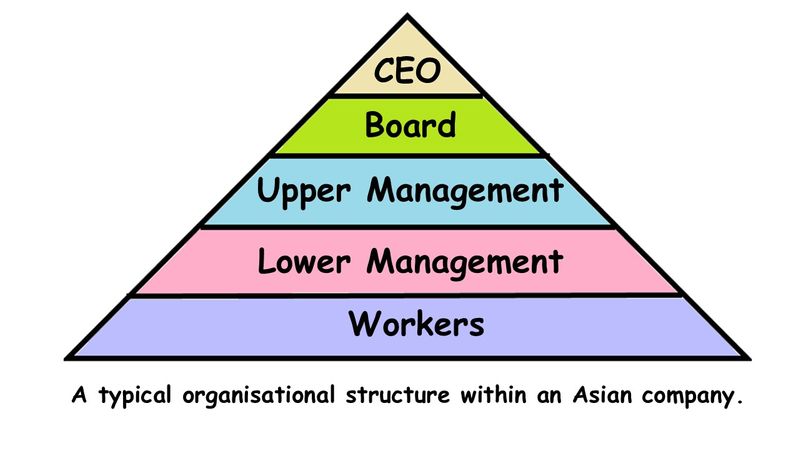 This image was created by the author using Microsoft Paint.
Adapting to cultural differences regarding hierarchy will ensure you're more successful when working for an Asian company.
Titles
When talking to someone senior, it is important to speak formally and use their title until invited to address them by their first name.
What you should say: "Good morning, Director Wu."

What you shouldn't say: "Good morning, Ethan."

Seniority Matters
It's not just a title that affects how senior someone is, but also their age and the time they have been with the company. You should show as much respect to people who have been there longer than you as you do to your boss.
An example of how seniority plays a role in Asian companies:
John was a new colleague from the UK working in a Chinese company. He was invited to a meeting by his project manager, but not by the senior manager who had called the meeting.
John saw that his senior was annoyed and suddenly realized that he wasn't supposed to be at this meeting. If the senior manager had wanted John there, he would have invited him himself.
The Silence Factor
Unlike in a European company, it's important that you remain silent and let more senior members of the organisation speak first. You should never directly challenge your boss in front of others, as that is a major "faux-pas".
Quiz
Your boss says something you disagree with in a meeting. What should you do? Select all that apply:
Did you know?
Subscribe for more quick bites of learning delivered to your inbox.
Unsubscribe anytime. No spam. 🙂
Work-Life Intergration
Adapting to cultural differences around work-life balance is one of the biggest challenges many Europeans face when working for Asian companies. If you understand that work and life are much more integrated in Asia, then you are likely to fit in with your new colleagues much better.
Leaving On Time
In Europe, it's normal to leave the company after having been there for 8 hours, as long as there is nothing urgent to do.
In Asia, this is often not the case. In many organisations, there are often very tight deadlines that require employees to stay late until they're finished. There may also be a culture of nobody leaving before the boss, as this shows a lack of dedication.

Socializing and Relationships
In Asia, businesses are built on deep personal trust and long-term relationships. This often requires time spent outside of work with colleagues, such as post-work drinks or dinners.
While in Europe this may be optional, in Asia this is mandatory. Spending time with your colleagues allows you to build the connections you need to be successful. Adapting to cultural differences around social obligations is tricky, but it can allow you have a full and rich understanding of another culture.
Take Action
While it may seem daunting to go and work in a new culture, it can be a really interesting and exciting. Make sure you do your research ahead of time and understand as much as you can about the culture you're going to work in.
 Photo by Brooke Cagle on Unsplash
Your feedback matters to us.
This Byte helped me better understand the topic.