
Imagine this...
You sit down to write an important email. Nothing fancy, just an update to your team.
But the moment you place your hands on the keyboard, your mind goes blank. The blinking cursor feels louder than your thoughts. You type a sentence…delete it. Type another…delete. Suddenly, what should take two minutes feels impossible.
 Photo by Alex Knight on Unsplash
Then you remember: confident writing isn’t about being perfect on the first try. It’s about having tools that help you start strong and shape your ideas with clarity.
Did you know?
1. Plan Your Writing for Better Results
Asking strategic questions during the brainstorming phase can go a long way. They can help you clarify your ideas, purpose, and audience before you ever begin drafting.

How to Be a Confident Writer by Planning
Ask yourself the following questions as you begin your draft:
Who am I writing to?
Identify your primary audience — the person or group who matters most for this message. Effective communicators base their writing on who will read and use it.
Consider your audience's perspective and needs so your writing is relevant and helpful.
What do they need to know?
List out the key information or insights your audience needs.
Think about what they already know, and what assumptions you can or can’t make.
Use prewriting techniques (brainstorming, questioning, mapping) to explore and capture ideas.
Why am I writing this?
Define your main objective: Is it to inform, persuade, request, or update?
Clarify the desired outcome: What do you want your audience to think or do after reading this?
 Examples:
“The purpose of this message is to update you on the project timeline and propose next steps.”
“The purpose of this message is to ask for your approval on the budget proposal.”
“The purpose of this message is to explain the rationale behind our new marketing strategy.”
Did you know?
Quiz: Alignment & Focus

Which paragraph BEST demonstrates professional writing that is aligned with the audience and stays focused on the topic?
In today’s fast-paced work environment, clear communication is essential for project success. Team members need concise updates that highlight progress, obstacles, and next steps so everyone can make informed decisions. Using structured reports and short, targeted emails ensures that colleagues receive the information they need without spending time sorting through unnecessary details. Regular check-ins combined with precise written updates create a culture where tasks are completed efficiently and accountability is maintained.
Project success depends on many factors, including the quality of office furniture, the color of the walls, and whether team members like the coffee in the break room. While emails and reports are somewhat helpful, creativity can be inspired by many things unrelated to work, such as decorating the workspace or casual watercooler chats. In some cases, spending time designing a comfortable environment may even increase productivity, though results can vary widely between teams and projects.
When drafting updates for a team project, it’s important to include all details, even minor ones. For example, mentioning which fonts were used in the report, every small change in the budget spreadsheet, and the order of minor tasks can be helpful. This level of detail ensures nothing is overlooked and provides a thorough record, even though some readers may need to skim through the long updates to find the main points.
Quiz
Which paragraph BEST demonstrates professional writing that is aligned with the audience and stays focused on the topic?
2. Draft Freely, Edit Later
Drafting freely can help you be a confident professional writer by reducing self-criticism and allowing ideas to flow without pressure. This can increase your productivity and belief in your ability to generate strong content.
How to Be a Confident Writer by Drafting
With a "Quick, Imperfect" draft! Before you worry about polished sentences, focus on capturing your main idea quickly and simply.
Try this:
Write your core point in 1–2 fast sentences.
Allow yourself to write without pausing for grammar, tone, or structure.
Imagine you are explaining the idea to a friend. Be informal but clear.
This aligns with research showing that idea generation and refinement should be treated as separate cognitive tasks.

Don’t Judge Your Words Yet
During drafting, avoid:
Re-reading every sentence.
Backspacing or editing.
Trying to sound “professional” too early.
 Photo by Towfiqu barbhuiya on Unsplash
Confidence Builder
Your first draft is not your final product...it’s raw material.
Writing scholars call this the “knowledge-transforming process”: you generate ideas first, then shape them into meaning later.
Remind yourself:
A messy draft means your brain is doing its job.
Clarity comes in the revision stage, not the drafting stage.
At this stage, progress is more important than perfection, and focusing on forward movement helps build writing confidence.
Quiz
Which statement BEST captures why messy or fluent drafting benefits writers during the writing process?
Subscribe for more quick bites of learning delivered to your inbox.
Unsubscribe anytime. No spam. 🙂
3. Shape Your Writing with the P.A.L. Structure
The P.A.L. structure is a simple framework used to keep writing focused and organized. It helps writers stay on topic by breaking a paragraph into three parts:
Point (the main idea)
Add (support or evidence)
Link (connect back to the main topic or transition to the next idea).
This structure ensures that each paragraph has a clear purpose, relevant support, and a smooth connection to the overall argument or narrative.
How to Be a Confident Writer with P.A.L.
 Point: State the Main Idea First
Example: “Here’s an update on the project timeline.”
Why it works: Readers form mental models based on the first sentence they see. Providing the point immediately anchors their understanding.

Add Detail: Give Needed Context or Evidence
Example: “We encountered a delay due to new data checks, which pushed the review back by 24 hours.”
Why it works: Readers need just enough detail to understand the point — but not so much that it overwhelms them.

Link to Next Steps with a Clear Action, Timeline, or Conclusion
Example: “I will send the updated file tomorrow by 3 PM.”
Why it works: Explicit next steps reduce uncertainty and improve task follow-through.
 Try it Out!
Screenshot the graphic organizer below to use with your next writing project. It will help you stay on topic, organize your ideas, and confidently produce a well-thought-out piece of writing.
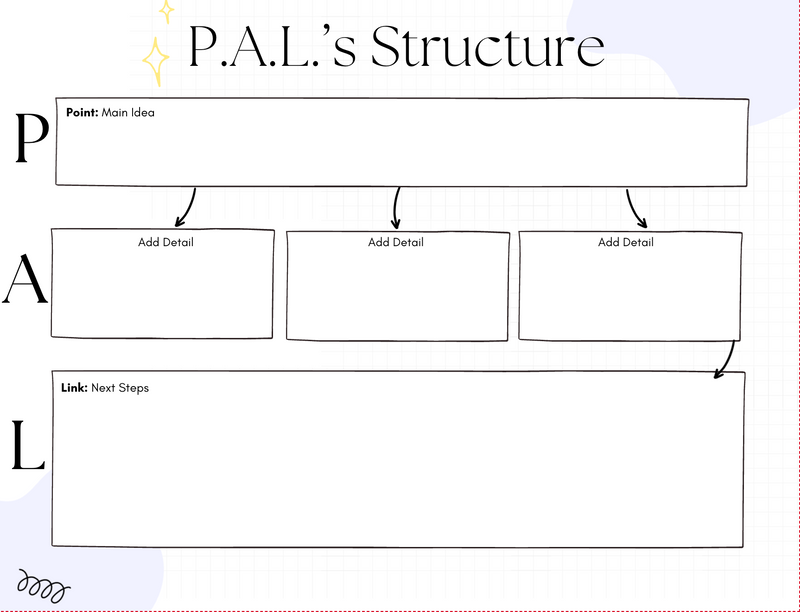 Template created by Shivohn Wehling using Canva
Did you know?
4. Polish Your Writing with the C.A.T. Check
This checklist gives you a simple, repeatable way to strengthen your writing with clarity, purpose, and polish. By focusing on clear sentences, confident tone, and trimming unnecessary words, you can quickly see measurable improvement in your work — another way to become confident with every revision.
How to Be a Confident Writer with C.A.T.
 Clarity: Are your sentences simple and direct?
Look for:
Long, tangled sentences.
Passive voice where active voice is better.
Ideas buried in unnecessary detail.
Examples:
Messy: “It might be beneficial if perhaps we consider reviewing the plan again.”
Clear: “I recommend we review the plan again.”
 Audience: Is your tone respectful and confident?
Check for tone cues:
Does it sound professional?
Does it show confidence without being aggressive?
Will the reader feel respected and informed?
Example: Uncertain: “Sorry, I’m not sure, but we could maybe try another approach?” Confident: “I recommend trying another approach.”
 Trim: Remove filler words.
Scan for:
very
really
kind of
maybe
sort of
possibly
Example:
Wordy: “This is really very important for us to kind of finish today.”
Trimmed: “This is important to finish today.”
Quiz: Editing
 Which C.A.T. step would BEST be used to edit this piece of writing?
During yesterday’s meeting, which was attended by most of the department except for a few individuals who were unable to join due to various scheduling conflicts that had not been communicated beforehand, it was decided, though not entirely agreed upon by everyone present, that a comprehensive review of the new workflow system should be conducted by the team at some point next week, after the preliminary feedback, which has been partially collected but not yet fully organized, is forwarded to the operations group, where it will be examined before any final recommendations are made.
Quiz
Select the best option for the passage above:
Take Action
Confident writing doesn’t require fancy words, just a clear process: Plan → Draft → Structure → Polish
 Learn more about how to become a confident professional writer:
Your feedback matters to us.
This Byte helped me better understand the topic.