
Can someone be so empathetic that it becomes overwhelming — even unhealthy?
Imagine yourself like a foam sponge. When people share their feelings, you soak it all up — their sadness, stress, fear, and even excitement or joy — until you feel heavy inside.
 This experience is rooted in empathy: the ability to understand and share the feelings of another person. When empathy becomes constant, intense, and overwhelming, it’s often referred to as hyper-empathy.
Recognizing the signs of hyper-empathy can help you protect your emotional energy while still caring deeply about others.
Types of Empathy
To understand hyper-empathy, it helps to first look at the three main types of empathy.
1. Emotional Empathy: The Feeling Type
 You feel other people’s emotions strongly.
Example: Your friend is anxious, and suddenly you feel anxious too.
2. Cognitive Empathy: (The Understanding Type)
 You understand someone’s emotions without absorbing them.
Example: You can tell your colleague is frustrated from their tone and facial expression, so you decide to give them space.
3. Compassionate Empathy: The Balanced Type
 You understand, you care, and you take healthy action — without draining yourself.
Example: You comfort a friend, support them, but don’t carry their feelings home with you.
Quiz
Your friend shares difficult family news. Which response best displays compassionate empathy?
What is Hyper-Empathy?
Hyper-empathy happens when emotional empathy (the feeling type) becomes too strong, and cognitive empathy (the understanding and boundary-setting type) doesn’t balance it.
In this case, you don't just notice or understand people's emotions. Your brain actually interprets them as if they're your own.
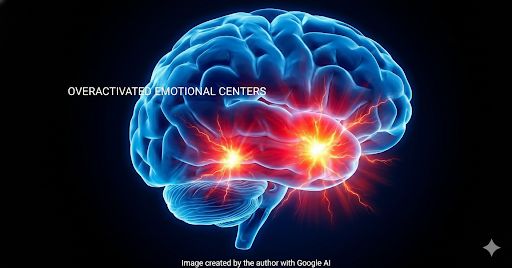
It applies to both positive and negative emotions:
Someone is excited → you feel the rush. “I’m buzzing too — I can’t calm down.”
Someone is overwhelmed → you feel drained. “Why do I suddenly feel so heavy?”
Hyper-empathy is not a medical diagnosis, but a recognized emotional pattern where empathy becomes overwhelming instead of helpful.
Did you know?
Let's Talk About the Key Signs
 Hyper-empathy often shows up quietly in everyday moments, leaving you more affected than you expect. Read through the signs below and notice what feels familiar:
You feel people’s emotions very deeply.
Example: Your friend is anxious about a meeting, and suddenly you feel anxious for the rest of the day — even after they’ve moved on.
You notice the smallest emotional changes.
Example: A friend replies with a slightly colder “okay,” and you spend the whole day wondering if you upset them.
You carry other people’s worries as if they’re yours.
Example: Someone tells you they’re stressed about money, and you spend the evening feeling anxious — almost like you owe the bills.
You feel responsible for fixing everyone’s problems.
Example: A colleague vents about work pressure, and you instantly start thinking of ways to solve it, even when it has nothing to do with you.
You get emotionally drained very quickly.
Example: After attending an emotionally heavy birthday, event, or family gathering, you leave exhausted and need hours (or days) to recharge.
You care so much that it sometimes hurts.
Example: You check in on several people every day, but when no one checks in on you, you stay silent — because you don’t want to “burden” anyone.
Quiz
After helping a friend vent, you feel drained and anxious all evening. Which signs are these?
Subscribe for more quick bites of learning delivered to your inbox.
Unsubscribe anytime. No spam. 🙂
The Reasons Behind Hyper-Empathy
Hyper-empathy doesn’t appear out of nowhere. Some common reasons it happens include:

Childhood emotional overload: Growing up around constant conflict or strong emotions can make you highly tuned into others’ feelings.
Emotional neglect or abandonment: Missing emotional support as a child can teach you to over-focus on others to stay connected.
Trauma or long-term stress: Abuse, illness, or ongoing stress can make your nervous system extra sensitive to emotions.
High sensitivity or caregiver conditioning: Some people are naturally very sensitive, or learned to over-feel by always taking care of others.
Did you know?
Can Hyper-Empathy Be Fixed?

First, know that hyper-empathy is not a disorder or medical illness — it’s simply an emotional pattern. The good news? It can be managed with simple, practical techniques:
 Emotional Boundary Pause
Ask: “Is this feeling mine or theirs?”
Check out what emotional boundaries are and why they are important.
 Mindfulness & Meditation
Stay grounded and aware of your own emotions.
Use these free guided meditation practices to help with mindfulness and emotional regulation.
 Journaling
Separate your feelings from others’ by writing them down.
Use this helpful journaling guide to start a journaling practice.
 Counseling or Therapy
Seek support if your emotions feel overwhelming.
Quiz
Your close friend is about to give a presentation and comes to you in a panic. What should you do next?
Did you know?
Take Action
 Ask yourself:
Your feedback matters to us.
This Byte helped me better understand the topic.