
 Photo by Andy Li on Unsplash
Ever taken a test where you had to visualize shapes rotating, or picture what a flat piece of paper would look like when folded? You probably wondered: "Why are they asking me this?"
Spatial reasoning tests measure how your brain visualizes and manipulates shapes in space. Most students feel confused by them. But spatial reasoning skills actually matter.
The good news? This isn't just test prep. It's the same skill architects, surgeons, and game designers use every day. Get better at this, and you're training a skill that actually matters outside the classroom.
What Are Spatial Reasoning Tests?
Spatial reasoning tests measure how your brain visualizes and manipulates shapes and objects in space.
They test your ability to "see" things in your head.
Have you ever tried to solve a Rubik’s Cube? Then you've completed a type of spatial reasoning task!

What spatial reasoning tests ask you to do:
Rotate 3D shapes mentally and figure out what they look like from different angles
Unfold flat patterns and imagine what 3D object they make
Find hidden shapes inside larger images
Match objects that are rotated or flipped
Solve puzzles with blocks or pieces
Predict patterns
Why it's called "spatial reasoning":
Spatial = space (how things exist in 3D)
Reasoning = thinking and problem-solving
Example
This example question will give you a good idea of what a spatial reasoning test might ask of you:
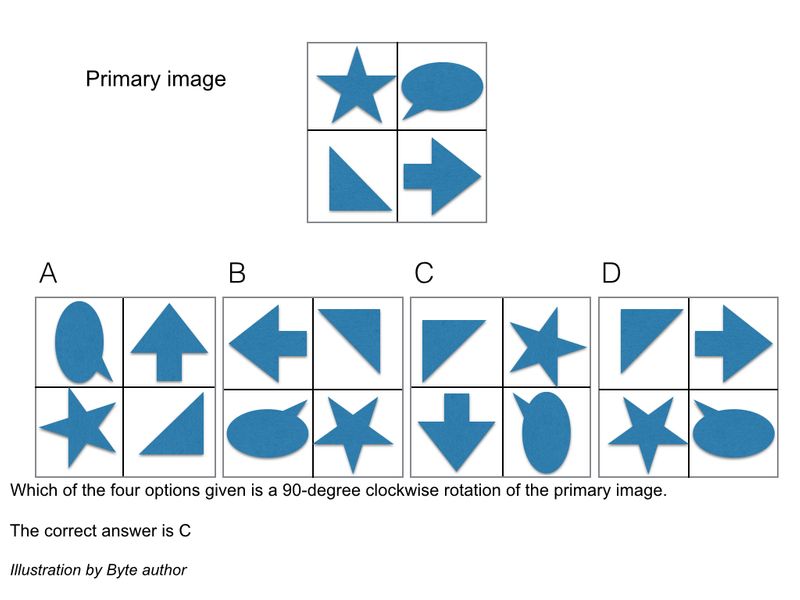
Different Types of Spatial Reasoning Tests
There are several types of spatial reasoning tests. Knowing what to expect helps you feel less nervous. Here are some of the most common types.
Below are videos for each type of spatial reasoning test. Feel free to watch just the first example or the whole video — either way, you'll get the idea.
Type 1: 2D Rotation
You see a flat shape. It rotates. You pick which rotated version matches.
Type 2: 3D Rotation (Cube Unfolding)
You see a flat pattern (called a "net"). Imagine it folding into a 3D cube. Which cube matches?
Type 3: Pattern Matching & Sequences
A grid or sequence shows you a pattern. You find what comes next or what's missing.
Type 4: Perspective/Viewing Angles & Mirror Images
You see an object. You have to figure out what it looks like from a different angle or as a mirror image.
Check out this mirror image example test.
Most tests mix these types. Knowing them means you can practice each one separately and build confidence.
Quiz
Your friend says: "I'm really bad at spatial reasoning tests because I can never visualize how a flat piece of paper will fold into a 3D shape."
Based on what you've learned, what would you tell them?
 They're probably not good at any spatial reasoning tasks.
 They should give up on spatial reasoning entirely.
 Spatial reasoning is something everyone's born with, so they can't improve.
 They struggle with one specific type but might be strong at other types.
Quiz
Chose the correct option:
Why Schools Use These Tests (And Why They Matter)
Schools use spatial reasoning tests to measure a specific thinking skill, how well your brain works with shapes and space.
It's not about being "smart" or "not smart." It's about one particular ability.
These tests help:
Identify your spatial reasoning strengths
Predict success in math and STEM subjects
Guide you toward careers that match your abilities
Understand how you learn best
Help you discover talents you didn't know you had
Why is spatial reasoning important in reality?
Many real jobs rely on spatial reasoning:
Architects and engineers (designing buildings, bridges, machines)
Surgeons and doctors (visualizing inside the body)
Pilots and astronauts (navigating 3D space)
Graphic designers and video game creators
Mechanics and construction workers
Scientists and researchers

If you have strong spatial skills, careers like architecture, engineering, and design could be a great fit.
Still building these skills? No problem! you can train yourself in spatial reasoning, or lean into careers that play to your other strengths.
Did you know?
Subscribe for more quick bites of learning delivered to your inbox.
Unsubscribe anytime. No spam. 🙂
How to Prepare and Practice
Preparation is the key. You don't need to be naturally good at spatial reasoning tests, you just need to practice:
Start 2-3 weeks early. Your brain needs time to build these skills.
Master one type at a time (cube rotation, then patterns), 15-20 minutes daily, easy to hard.
Use real objects: rotate dice or blocks while solving problems.
Sketch and narrate: drawing your fold/rotation and saying it out loud ("rotating 90 degrees...") both help your brain visualize.
Play games like Tetris, Minecraft, or Portal. You're training without realizing it!
Learn from mistakes: ask why you got it wrong, every time.
Try some free resources.
Quiz
You have a spatial reasoning test in 2 weeks. You find cube unfolding really hard, so you're thinking about different ways to practice:
Spend the whole 2 weeks doing only cube unfolding problems, cramming 1-2 hours every day until you get it perfect.
 Start with easy 2D rotation problems for 3-4 days, then move to harder cube unfolding for the rest of the time, practicing 20 minutes daily.
 Skip practice this week and do all your practicing the week before the test.
 Play Tetris for an hour straight instead of doing structured practice.
Quiz
Which approach is most likely to help you improve?
What Your Results Tell You About Your Brain
Your spatial reasoning score doesn't measure how smart you are. It measures one specific skill: how your brain handles visual and spatial information.
What the test reveals:
How you prefer to learn (through pictures, listening, hands-on, etc.)
Which type of problem-solving feels natural to you
What careers might play to your strengths
Where you might need to practice more
If you score high:
Your brain is naturally good at visualizing and rotating objects mentally. You might prefer learning through images, diagrams, and hands-on building. Careers in design, engineering, or architecture might feel natural to you.
If you score low:
Your brain might prefer working with words, numbers, or sounds instead of shapes. You might be great at writing, math, languages, or music. Low spatial reasoning doesn't mean you're "bad at thinking" — it just means spatial isn't your strongest skill yet.
Did you know?
Take Action
Try these practice tests!
Cognitive Train (with answer key)
OPC Assessments (with answer key)
STEM Education Research Centre (without answer key)
Your feedback matters to us.
This Byte helped me better understand the topic.